WordPress runs about 40% of all websites (W3Techs, October 2026), and for good reason: it’s free, open source and can be bent into almost anything. But for a marketing site, the pages a company uses to explain itself and win customers, it often costs more upkeep than it’s worth: plugins to update, a server to look after, and a designer who can’t move a section without a developer.
Framer is a website builder where you design, edit and publish in one place, with hosting included. Here are ten reasons to move a marketing site from WordPress to Framer, followed by the cases where WordPress is still the better choice, and how to switch without losing your search rankings.
1. You design on the page itself
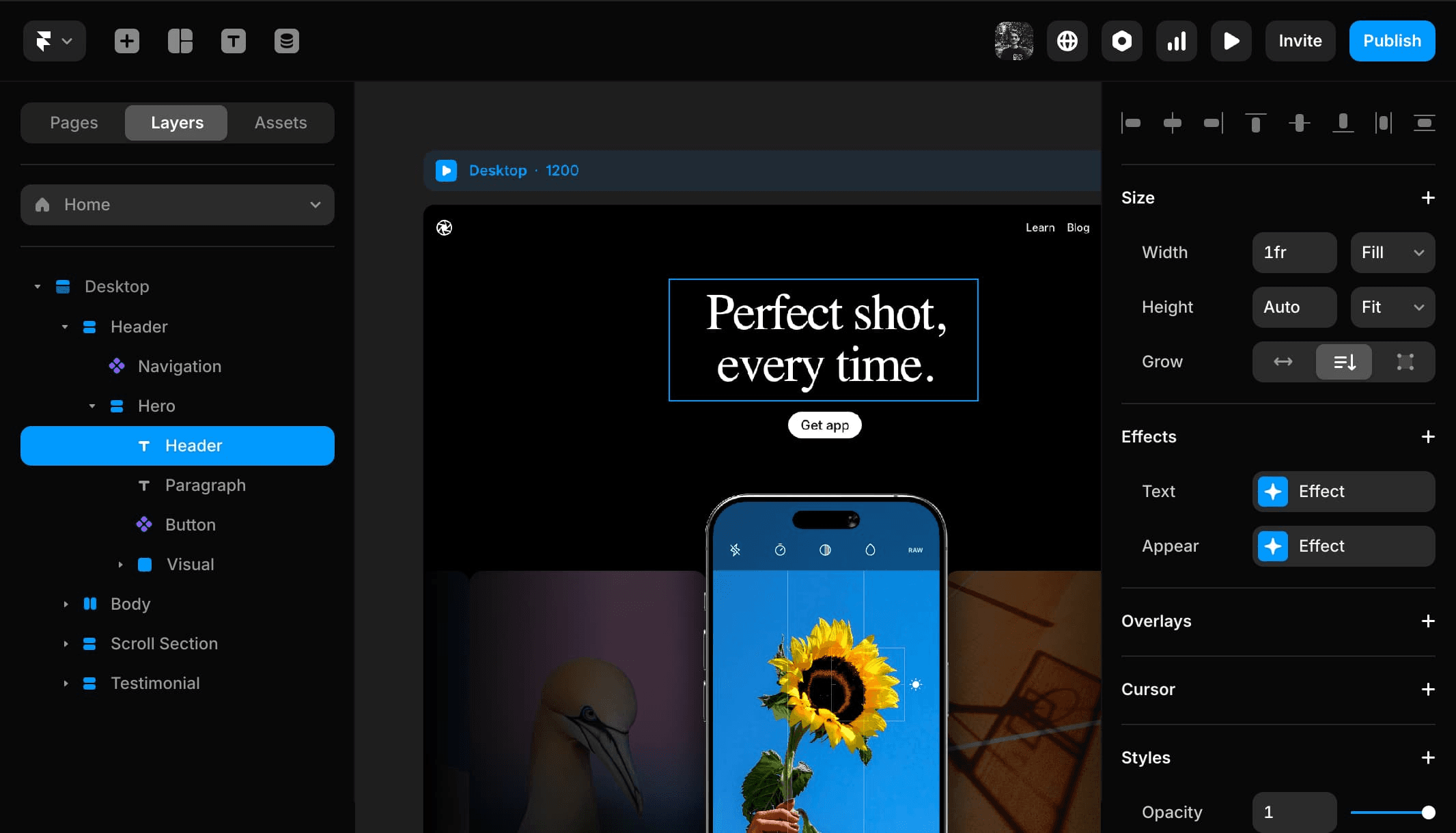
In WordPress, what you see while editing is usually an approximation: a block editor or a page builder on top of a theme, with the real result in a separate preview. In Framer the canvas is the page. What you arrange there is what gets published.
That moves layout work from developers to designers. Spacing, type and whole sections can change the afternoon someone asks, without touching a theme file or waiting on a ticket.
2. Every screen size is in view

Framer shows the desktop, tablet and phone versions of a page side by side. A change made on desktop carries down to the smaller sizes, and anything that should differ on a phone is set on the phone version, where you can see it.
On WordPress, how a page behaves on a phone depends on the theme and the page builder, and is often discovered after it’s live.
3. Animation is part of the editor
Entrance effects, scroll effects, hover and press states and interactive components are set from a panel in Framer, not added with a plugin or custom JavaScript. Framer began as a prototyping tool, and it shows: motion is a core feature rather than an add-on.
Use it with care. Large or constant movement can make some visitors unwell, and accessibility rules expect a way to pause it. Our guide to making your website safer for motion-sensitive users covers what to check.
4. Hosting comes with it
A WordPress site needs a host, a PHP version, a database, caching and usually a CDN, and someone to choose and look after each of them. A Framer site is published to Framer’s global network, with its SSL certificate set up automatically.
Publishing is atomic: each new version goes live all at once, with no downtime, so a visitor never lands on a half-published page.
5. There’s nothing to patch
Most WordPress security problems don’t start in WordPress itself. Patchstack counted 11,334 new vulnerabilities in the WordPress ecosystem in 2025: 91% in plugins, 9% in themes, and just six in WordPress core. Nearly half weren’t fixed by the time they were made public (State of WordPress Security in 2026).
A Framer site has no server-side plugins or themes to keep updated, no database of your own and no admin login page on your domain for bots to try. Framer runs and patches the platform. Custom code and third-party embeds still need the usual care, but there’s far less to watch.
6. It’s fast without tuning
Framer optimises pages and images when you publish and serves them from its global network, so a new site starts in good shape on Core Web Vitals, the speed and stability measures Google reports in Search Console. Getting a WordPress site there usually takes a good host plus caching and optimisation plugins.
It isn’t automatic, though. Heavy video, oversized images, piles of animation and third-party scripts slow a Framer site like any other. Test real pages in PageSpeed Insights, and note that Interaction to Next Paint (INP) replaced First Input Delay as a Core Web Vital in 2024. Speed is a modest ranking signal; the bigger payoff is visitors who stay.
7. The SEO basics are built in
Framer creates the sitemap.xml and robots.txt for you and lets you set a title and description for every page and every CMS item. It handles image alt text, structured data added as JSON-LD through custom code, and redirects. On WordPress, the same usually comes from an SEO plugin such as Yoast or Rank Math.
Two limits to know: redirects need the Pro plan, and no builder does the writing. Titles, descriptions and pages that answer what people search for still decide where you rank.
8. Your team can publish without a developer
Framer’s CMS holds repeating content, like blog posts, case studies and job listings, in collections your team fills in through a form, with each item’s page built from one template. Several people can work in the same project at once, see each other’s changes live, and leave comments on the canvas.
Extra editors are paid seats, and each plan limits how many collections and items you can have. For a typical marketing team it still means changes ship the day they’re written, not when a developer is free.
9. Every change can be undone
Framer saves versions as you work: every five minutes over the last four hours, every hour for the last day, then daily. You can open an old version, copy back what you need, or restore the whole thing. On the Pro plan, a staging site lets you check changes at a separate address before they go live.
On WordPress, backups and staging depend on your host or another plugin, and restoring a backup often rolls back everything, including changes you wanted to keep.
10. One bill instead of many
A WordPress site’s cost is spread out: hosting, a premium theme, yearly licences for page builder, SEO, security, backup and form plugins, and a developer’s time for updates. Framer puts hosting, SSL, the CDN, the CMS and analytics into one plan. In October 2026 Framer listed its Basic plan at $10 a month and Pro at $30 a month, with extra editors, languages and A/B testing charged on top.
Which comes out cheaper depends on the site. The difference is that Framer’s cost is mostly one known line, rather than a dozen renewals.
When WordPress is still the better choice
Framer is built for marketing sites. Stay on WordPress, or build something custom, if your site is mainly:
- A shop. Framer has no built-in store; selling means third-party plugins, often handing off to Shopify for checkout. WooCommerce runs a full store inside WordPress.
- Members only. Logins, paid memberships, courses and forums need third-party tools in Framer. WordPress has mature plugins for each.
- A large publication. Thousands of articles, many authors and editorial workflows outgrow the limits of Framer’s CMS.
- Something you must be able to move. WordPress is open source and runs on any host. Framer doesn’t export sites for hosting elsewhere, so you’re tied to its platform and its prices.
- Part of a product. When the site is really an application, with accounts, dashboards and custom logic, a coded framework like Next.js fits better. We’ve written about handling SEO in Next.js for that case.
How to switch without losing your rankings
A rebuild is the easiest way to lose search traffic built up over years, and most of the loss comes from addresses that change without a redirect. Before you launch:
- List every page that matters. Export pages and their clicks from the Performance report in Google Search Console, and crawl the old site so nothing is missed.
- Keep the addresses where you can. Framer lets you set page paths and CMS slugs, so many old addresses can stay exactly as they are.
- Redirect what has to change. Point each old address at its new one with a permanent redirect, including dated post URLs and category pages that get traffic.
- Carry the page details over. Titles, meta descriptions, headings, image alt text and structured data, page by page.
- Check after launch. Submit the new sitemap in Search Console, watch the Page indexing report for 404s, and compare clicks over the following weeks.
For most marketing sites, Framer removes the upkeep WordPress needs, puts design in designers’ hands, and is fast and secure without tuning. For shops, members’ areas, large publications and products, WordPress or a custom build is still the better tool. Choose by what the site has to do, and if you move, bring your rankings with you.